


ReviewTP-Link Tapo
Tapo RV30 Max Plus review: camera-free and self-emptying, a pet-hair question
Verdict
Swept's call: the Tapo RV30 Max Plus is a buy for a small home with bare floors where any pet has a short coat. It empties itself, has no camera or microphone, and joins Matter, but it is weak on pet hair pressed into carpet.
On paper, the Tapo RV30 Max Plus is the robot privacy worriers keep asking for. It empties itself and carries no camera or microphone. Matter lets your smart home start and stop it, and it costs under $250. Then the dog walks across the rug. Swept's call: buy it for an apartment or small house of wood, tile or LVP where nobody sheds much, or nobody sheds at all. On bare floors it lifts nearly all the pet hair. In carpet, a third or more stays behind, and the hair it does catch winds around the brush.
BuySmall hard-floor homes, no heavy shedder
Tapo RV30 Max Plus: what the box promises against what you get
Price band: under $250


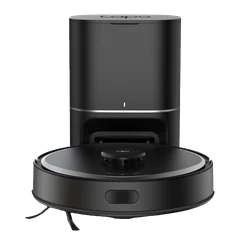


TP-Link's US datasheet reads like a confident supplier's. It lists 5,300 Pa of suction, lidar navigation, a self-emptying dock, a clip-on mop and Matter. Pascals are the horsepower of the robot vacuum aisle, easy to print and hard to feel. No lab has measured this robot's suction, and the floor settles the matter anyway.
On hard floors most of the promises hold. Labs found it lifts cat litter almost completely from hardwood. The quiet claim holds too: TechGearLab measured 55.5 dB, close to TP-Link's 52 to 55 dB, though testers heard a high-pitched whine. The loud part is the dock, a few seconds at 76.3 dB each time it empties. The datasheet says a bag lasts about two months, and Wirecutter expects the same. A robot box that doesn't stretch its own number is rarer than it should be.
It's built for a small place. The dock stands 13 in tall on a small footprint, and TechGearLab judged the robot best suited to smaller homes and apartments. It falls short on fine grit, leaving sand on carpet and hard floor alike. That's the grit by the back door, and it will still be there tomorrow.
Will it keep up with a shedding dog?
This is the whole review. Tom's Guide found it left almost no pet hair on hardwood but collected only 67.8% from carpet. TechGearLab worked real fur into carpet and got 40%. The methods differ, so the numbers don't average. They agree on direction: bare floors are fine and carpet isn't.
The hair it does catch tends to stay on the brush. Testers needed about ten minutes and scissors to clear a tangle, and long human hair wraps it too. The US manual also rules out high-pile and fringed carpet. If you have a husky and a living-room rug, this isn't your robot. Our pet hair roundup sorts carpet homes with shedders by what else is going on in them. A dog or cat that sheds hard, on carpet or on deep rugs over hard floors, gets the Dreame X60 Max Ultra Complete. If your pets never have accidents and the doorways are nearly flat, under an inch, the roundup picks the Dreame L60 Ultra PE. If someone picks up socks and cords before each run, the Dreame D20 Plus handles carpet, rugs and shedding pets, and it is the overall pick of our budget robot vacuum roundup.
Bare floors don't settle it on their own, either. Where a cat or dog leaves a fresh layer of fur on the wood every day, the pet hair roundup's choice is the ECOVACS DEEBOT T90 Pro Omni. If you want that home camera-free and the pet is house-trained, both the pet hair roundup and our camera-free robot roundup pick the eufy Omni C28 instead, as long as a cloud-only app doesn't bother you.
Will it get past socks, cords and chair legs?
No, and the spec sheet nearly admits it. The obstacle line reads "LiDAR" and nothing else, which leaves the marketing copy's "Smart Obstacle Avoidance" doing a lot of work. Lidar sees walls and furniture, but it doesn't see socks. TechGearLab watched it run over socks and cords and trip on thin cords and chair legs. Pick up before it runs. It can't see a pet's accident either, so it's the wrong robot for a dog that sometimes has one indoors. On mostly hard floors, a pet with the odd accident calls for the eufy Omni S2, whose camera watches for the mess. Nobody has measured the Tapo's claimed 0.87 in (22 mm) threshold climb.
Is the mop worth using?
Only for a sticky drip. The pad clips on and can't lift itself, and labs found it handles light spills only, sometimes leaving residue. Because it can't lift, the US manual says to mark carpet areas before you mop. TP-Link's datasheet says to wash the cloth after every use, and Tom's Guide found the pad smells if you don't. Treat it as a vacuum with a damp-cloth accessory. If clean, mopped floors are the point of buying a robot, the camera-free roundup picks the Roborock Qrevo S Pro, which washes and dries its own mops.
Does the Tapo RV30 Max Plus have a camera?
No. TP-Link's US datasheet and user guide list no camera and no microphone, and TechGearLab agrees. Tom's Guide's review describes a front camera, which doesn't match the US paperwork. The likeliest explanation is that the reviewer mistook the sensor window for a lens. We point it out because a privacy-minded buyer could otherwise pass up the right robot. If no lens plus a Wi-Fi off switch is your brief, the Roborock Q7 M5+ below fits you better. If you want no lens in the house and a robot your smart home can drive through Matter, this one qualifies, and on that count we'd buy it.
Can it run without the internet?
Only partly. You can't switch its Wi-Fi off and keep cleaning. The manual's Energy Saving mode (hold the Dock button for 15 seconds) drops Wi-Fi, but after that the robot can only charge. Schedules live in the Tapo app behind a TP-Link ID. The manual's troubleshooting page says a schedule fails if your internet is down and the robot has restarted. I've seen that sort of line in plenty of supplier documents: it's a dependency that never made it onto the box.
Among camera-free robots, local control is its strength. It's the only one we've researched that offers any local route. Matter arrived with firmware 1.2.1 in February 2025, so Apple Home or Home Assistant can start and stop it on your own network. That version of Matter predates room selection, so it can't aim the robot at a single room. A developer's custom integration claims fully local control, rooms included. So far the only person vouching for it is the person who wrote it.
Support has been decent, though the paperwork is incomplete. US firmware updates ran through April 2026 and fixed real faults, such as the robot stopping when its brush jammed. None of the Tapo security flaws we found names a robot vacuum. No security-update end date is published for the US V1.80. Robots already on US shelves stay legal to buy and use, and makers may keep updating them until at least January 2029. A 2025 proposal to bar TP-Link routers has no final decision and doesn't name Tapo vacuums.
Local control isn't the same as running free of the cloud, though. Schedules still lean on the internet, and no dated patch promise covers this robot. If you want a robot that stays patched on a dated promise and keeps working with the cloud cut off, you're a different buyer. Our robot vacuum ban guide picks the Roborock Saros 20 for you, in homes with house-trained pets. It carries a camera, and the Tapo doesn't. The Tapo is for a camera-free home on bare floors that wants Matter and can live with an undated support window.
Will the dock last?
Nobody publishes failure rates for this model. One home's dock banged and smelled of burnt motor after a week, and its replacement failed after two days. Two owners in the same discussion report more than a year of reliable daily cleaning. None of them says which generation they own. The warranty runs one year, and Wirecutter reports parts are sold only as a set, so a worn brush means buying the whole kit. That's annoying, and it won't matter to most homes, because Roborock gives the Q7 M5+ the same one year.
Which RV30 are you buying?
Three robots share the name, and this review covers one of them. The US Tapo RV30 Max Plus is hardware V1.80, the 5,300 Pa robot with the self-emptying dock, and the white version is the same robot. The RV30 Max is that robot on a charge-only dock, so you empty the bin yourself. Buy the Plus unless you enjoy that job. The RV30 Max Plus Gen 2 is a newer generation with no US datasheet or firmware, and nothing here applies to it. Buy the one whose Amazon listing title says 5300Pa.
The call on the Tapo RV30 Max Plus
Some readers should look elsewhere, and the difference is in their homes:
- If dated support and cloud-free running come first, the ban guide's pick is the Roborock Saros 20, not this.
- If a shedder lives on your carpet or rugs, our pet hair roundup has three answers. The Dreame X60 Max Ultra Complete is for a hard shedder, including on deep rugs over hard floors. The Dreame L60 Ultra PE suits homes whose pets never have accidents and whose doorways are near flat. The Dreame D20 Plus suits a household that clears the floor first, and our budget robot vacuum roundup makes it the overall pick.
- If your floors are bare but fur turns up on them daily, the pet hair roundup's ECOVACS DEEBOT T90 Pro Omni copes better. If that home must also be camera-free and the pet is house-trained, the eufy Omni C28 is the pick in both that roundup and our camera-free roundup.
- If mopping matters as much as vacuuming, the camera-free roundup's Roborock Qrevo S Pro does the job this pad can't.
- If the pet sometimes has accidents indoors, the eufy Omni S2 suits a mostly hard-floor home. With carpet in the mix, the pet hair roundup's Dreame X60 Max Ultra Complete is built for it.
Everyone else in a small home with bare floors should read on. Clear the socks first and it will keep those floors clean without you. The mop is a bonus, not a reason to buy. It suits you best if you also want a camera-free robot that Matter can start and stop. For an apartment or small hard-floor home that is pet-free or keeps a short-haired pet, buy the Tapo RV30 Max Plus.
BuyIf you want a Wi-Fi off switch
Want a Wi-Fi off switch instead? Roborock Q7 M5+
Price band: under $400


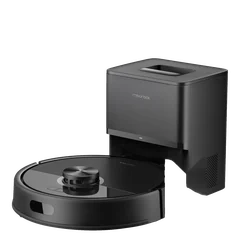


The Q7 M5+ suits the same small, tidy home, and it has the one thing the Tapo lacks. Roborock's US manual lets you switch its Wi-Fi off, and Roborock dates this model's security updates to June 2027. Its dock is smaller too, at 10.2 in tall against the Tapo's 13 in. You give up Matter: labs testing the same robot on a charge-only dock found none in the app. The catch is getting stuck. Several owners report it wedging on table bases and chair legs, and it has no front obstacle sensors. If switching off Wi-Fi matters more to you than Matter, we'd buy the Q7 M5+. Our Roborock Q7 M5+ review makes the full case.
BuySmall hard-floor homes, no heavy shedder
Who should buy the Tapo RV30 Max Plus
Buy it if your home is small, your floors are mostly bare, and nobody is shedding a winter coat onto the rug. If you're not sure that describes your home, the home-fit finder will settle it in a few questions. Our budget robot vacuum roundup chooses the Tapo for a small hard-floor home and gives its overall pick to the Dreame D20 Plus for carpet, rugs and shedders. Our camera-free robot roundup weighs it against the other robots without a lens. Keep the socks off the floor and the husky off the rug, and it earns its dock.
The evidence in full
23 sources
Pickup, split by floor
| Test | Hardwood | Carpet |
|---|---|---|
| Tom's Guide, kitty litter | 95.7% | 89% |
| Tom's Guide, pet hair | almost all collected | 67.8% |
| TechGearLab, real pet hair worked into carpet | not tested | 40% |
Tom's Guide scores hardwood and low-pile carpet separately, each from one run with a weighed bin. Its hardwood pet-hair result is far higher than its carpet result. TechGearLab works real pet hair into carpet and reports the share collected, without stating the amount or number of passes. Because the methods differ, the two carpet figures shouldn't be averaged. Both put pet hair in carpet as this robot's weakest area. TechGearLab also found the brushes tangle easily and take about ten minutes and scissors to clear, and it called the robot "extremely difficult to maintain". In TechGearLab's testing it also called a hard-floor job finished after five minutes with debris left on the floor. TechGearLab judged it best suited to smaller homes or apartments.
Claims against findings
| TP-Link US datasheet (V1.80) | What testers found |
|---|---|
| 5,300 Pa suction | Not measured by any source we read |
| Thresholds up to 0.87 in (22 mm) | Not measured; TechGearLab saw it trip on thin cords and chair legs |
| Up to 150 min in Quiet mode | Not measured |
| 52 dB Quiet, 55 dB Standard | 55.5 dB cleaning, with a high-pitched whine; 76.3 dB while the dock empties (TechGearLab) |
| Robot 3.9 in tall | 3.9 in (TechGearLab) |
| Dock 9 × 6.5 × 13 in | 9 × 6.5 × 13 in (TechGearLab); Wirecutter says it stands 3 in taller than the Q7 M5+'s |
| A bag lasts up to two months, hands-free | Wirecutter reports the company says three months and estimates about two |
| Obstacle avoidance: LiDAR | Runs over socks and cords, pushes small items several feet (TechGearLab) |
| Clip-on pad, 3 water levels, no lift | Light spills only, leaves residue, pad smells unless washed every week or two (Tom's Guide) |
Maintenance, from TP-Link's US datasheet
- Filter: clean weekly, replace every three to six months.
- Main brush: clean every two weeks, replace every six to twelve months.
- Side brush: clean monthly, replace every three to six months.
- Mop cloth: wash after each use, replace every two to three months.
Units and dates
TechGearLab, Tom's Guide (5 Feb 2025) and Wirecutter (guide updated 4 Aug 2026) all reviewed the RV30 Max Plus. None of them prints a hardware version. We treat their results as the original because it is the only RV30 Max Plus with a US datasheet and US firmware, and Amazon US search shows only the 5,300 Pa model. No results from other markets' units are used on this page. RTINGS and Vacuum Wars have not tested this robot in the sources we read. The white version is covered by the same US V1.80 user guide. TP-Link's Gen 2 US support page lists no US firmware or datasheet.
Firmware (US notes, hardware V1.8)
- 1.2.1 (2025-02-20): added Matter 1.3.
- 1.2.3 (2025-04-29) and 1.3.3 (2026-04-22): improved Matter, relocation and return to charge.
- 1.3.0 (2025-10-10): fixed the robot stopping after a main-brush jam and skipping carpet in some cases, and added security work.
No lab states the firmware it tested. Tom's Guide's review predates the brush-jam fix.
Disagreements that don't change the call
- Camera. Tom's Guide describes a front camera. TP-Link's US datasheet lists obstacle avoidance as LiDAR only, the US manual lists no camera or microphone, and TechGearLab's spec table says no built-in camera. The likeliest explanation is that the sensor window was mistaken for a camera.
- Runtime. TechGearLab's comparison table lists a longer manufacturer runtime than the 150 min on TP-Link's US datasheet. The cause is unresolved, possibly a table error or another market's spec.
- Bag life. The US datasheet says up to two months, while Wirecutter quotes the company at three. Both testers' estimates and the datasheet land on about two.
- Carpet. Wirecutter reports strong carpet dust pickup, while TechGearLab found sand left behind. The difference is debris type: dust and large debris come up, fine sand doesn't.
Owners
None of the threads establishes the owner's country or generation (original or Gen 2).
- Tiled apartment: the self-empty dock banged and smelled of burnt motor after one week, and the replacement failed after two days.
- Same thread: another owner reports more than a year of reliable daily cleaning of a large home.
- Two dogs, hard floors, about a year: vacuuming "great", but dog fur sometimes had to be cleared by hand, and the owner stopped mopping after two weeks.
- Local control: a developer reports his custom Home Assistant integration runs this model over the LAN without TP-Link's cloud, with rooms and zones (Oct 2026). No independent owner has reported on it yet.
The sample is far too small to give a failure rate.
Support and security
- No security-update end date for the US V1.80 appears in any TP-Link document we read.
- The NVD search found Tapo CVEs for cameras, hubs, plugs, bulbs and doorbells, with none naming an RV robot vacuum. TP-Link's advisory page lists no robot-vacuum advisory either.
- Home Assistant's core TP-Link integration controls Tapo vacuums locally but needs TP-Link cloud credentials to authenticate. It lists the charge-only RV30 Max, not this bundle.
- Matter 1.3 predates the Service Area cluster used for room selection, so room selection over Matter isn't expected. No source has tested it.
- No FCC ID was found on fccid.io or in the user guide. The robot is on sale in the US, and robots on the Covered List that were already authorized stay on sale.
- The CPSC recall API returns no recall titled "Tapo".
- Wirecutter reports a one-year warranty, with parts sold only as a set.
Research count
Research count for this page: 4 models weighed; 3 maker manuals among them; across this site's research, 497 sources kept in full; 148 Reddit threads read, kept as the reader's summary, not in full.
Sources
- TP-Link: Tapo RV30 Max Plus (USA) V1.80 datasheet (opens in a new tab)
- TP-Link: RV30 Max Plus & White (USA) V1.80 installation and user guide (opens in a new tab)
- TP-Link: Tapo RV30 Max Plus US downloads and firmware notes (opens in a new tab)
- TP-Link: Tapo RV30 Max Plus Gen 2 US support page (opens in a new tab)
- TP-Link: Security advisories (opens in a new tab)
- Roborock: Q7 M5+ US product page (opens in a new tab)
- Roborock: Q7 Series US user manual (opens in a new tab)
- Roborock: Software security support policy (opens in a new tab)
- Roborock: US service and warranty (opens in a new tab)
- FCC: Covered List (opens in a new tab)
- FCC: Covered List FAQs, robots and inverters (opens in a new tab)
- NVD: CVE keyword search, tapo (opens in a new tab)
- Home Assistant: TP-Link integration (opens in a new tab)
- TechGearLab: TP-Link Tapo RV30 Max Plus review (opens in a new tab)
- Tom's Guide: TP-Link Tapo RV30 Max Plus review (opens in a new tab)
- Wirecutter: The best robot vacuum (opens in a new tab)
- Vacuum Wars: Roborock Q7 M5 and M5+ review (opens in a new tab)
- RTINGS: Roborock Q7 M5 review (opens in a new tab)
- CyberInsider: TP-Link routers near US market ban after national security review (opens in a new tab)
- r/Tapo: Tapo RV30 Max Plus burnt out after 1 week (opens in a new tab)
- r/RobotVacuums: Anyone got experience with TP-Link Tapo RV30 Max (opens in a new tab)
- r/homeassistant: Local Tapo robot vacuum integration for Home Assistant (opens in a new tab)
- r/Roborock: Does anyone else find the Q7 M5+ to be absolutely useless? (opens in a new tab)